


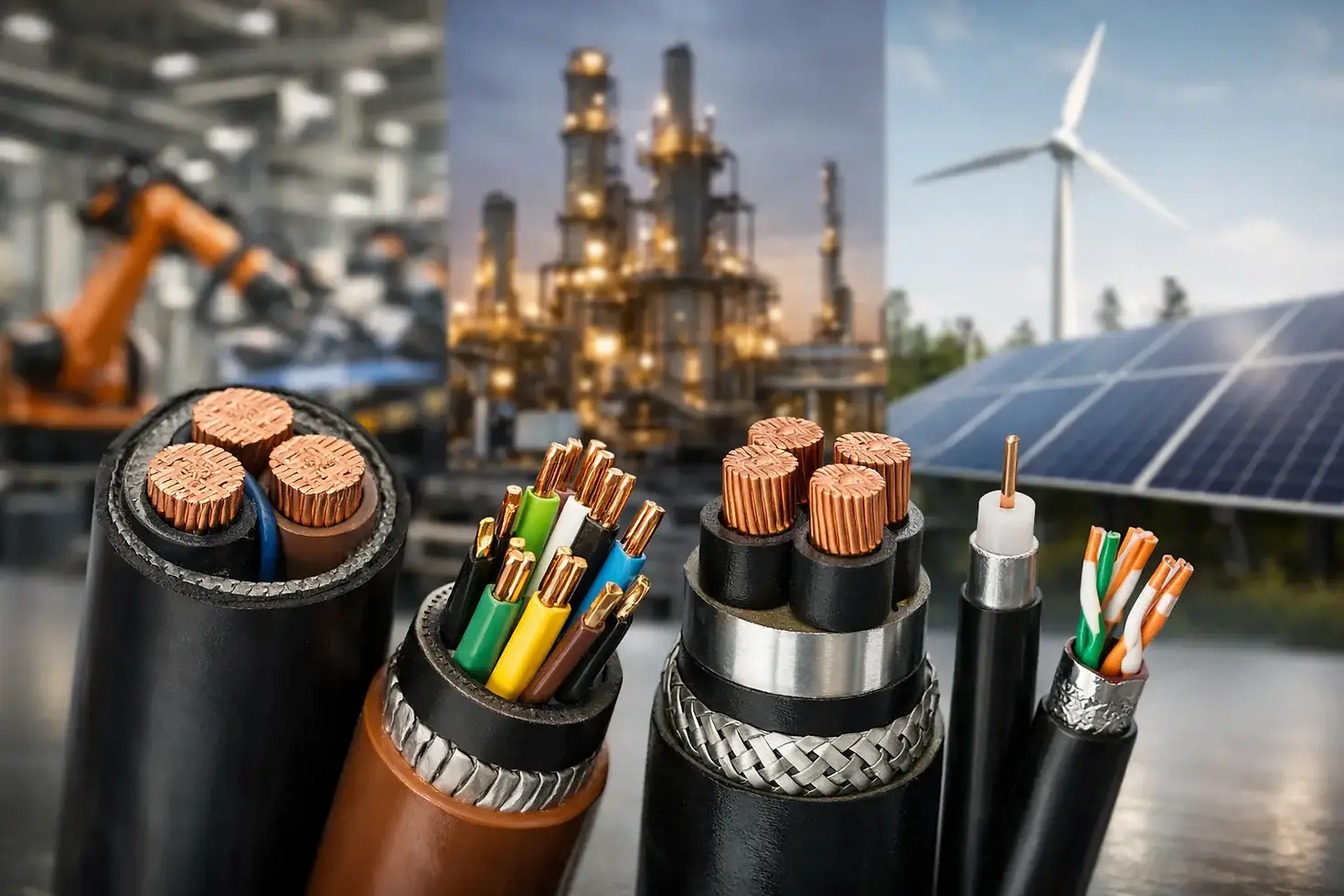
Industrial Cable Applications List for Projects

A cable may carry the correct voltage rating and still be the wrong choice for the job. Heat, oil, movement, electrical noise, installation method, and local compliance requirements can change the cable specification completely. This industrial cable applications list helps procurement teams, contractors, OEMs, and distributors connect each operating condition with the cable construction it requires.
Why Cable Application Determines the Specification
Industrial cable selection starts with the circuit function, but it cannot end there. A fixed feeder in a dry cable tray has different demands from a motor connection on moving equipment, even when both operate at the same voltage. The conductor size, insulation compound, sheath material, screening, flexibility, and armor must reflect how the cable will actually be installed and used.
Low-voltage power cables are commonly selected for voltage class, current capacity, voltage drop, short-circuit duty, and installation environment. Yet the details matter. A cable routed through a hot production area may require higher thermal resistance. A cable exposed to oils, sunlight, or moisture may need a purpose-designed outer sheath. Where electromagnetic interference is present, an unscreened cable can affect control signals and equipment performance.
The right approach is to define the application first, then confirm the electrical and mechanical specification. This reduces avoidable replacements, commissioning delays, and disputes over whether a supplied cable is fit for service.
Industrial Cable Applications List by System Type
Power Distribution and Building Feeders
Power distribution is one of the most common industrial cable applications. Low-voltage copper or aluminum power cables supply main panels, subpanels, transformers, switchgear, pumps, HVAC systems, production lines, and auxiliary buildings. The selection normally considers conductor material, cross-sectional area, voltage rating, allowable voltage drop, and installation method.
Copper is often preferred where compact conductor size, high conductivity, and termination performance are priorities. Aluminum can be a practical option for larger feeder sizes when weight and material cost are major commercial considerations. The trade-off is that aluminum installations need correctly rated lugs, suitable jointing practices, and careful attention to conductor size.
For fixed installation, PVC or XLPE insulated power cable may be specified depending on temperature duty, local standards, and project requirements. If the route includes outdoor exposure, buried installation, or industrial contamination, the jacket specification should be reviewed separately from the insulation rating.
Machinery and Motor Connections
Machine power cables supply motors, conveyors, compressors, mixers, packaging lines, and processing equipment. These installations often face vibration, repeated maintenance activity, tight routing, and contact with lubricants or cleaning materials. A standard fixed-installation cable may not have the flexibility or jacket resistance needed at the machine connection point.
Flexible copper conductors are generally used where a cable must be routed through compact equipment spaces or where limited movement is expected. For motor circuits, the buyer should provide load current, starting conditions, route length, ambient temperature, and whether the cable is installed in conduit, tray, or free air. These details affect conductor sizing and thermal performance.
Where motors are fed by variable frequency drives, cable selection deserves added attention. VFD systems can create higher-frequency electrical effects that stress motor insulation and generate interference. A properly designed VFD cable may use symmetrical grounding conductors, suitable insulation, and shielding to limit emissions and support reliable drive-to-motor operation. It depends on the drive, cable length, grounding system, and manufacturer requirements.
Control and Automation Circuits
Control cables carry low-voltage signals between control panels, contactors, relays, sensors, actuators, and machine components. Their role is different from power transmission: the priority is dependable signal operation and organized multi-core routing.
Multi-core control cable is commonly used in industrial machinery, factory automation, HVAC control systems, and process equipment. Core numbering, color identification, conductor flexibility, and shielding requirements should match the panel design and field termination plan. A control cable with the right number of cores but unsuitable identification can slow installation and increase wiring errors.
Unshielded control cable may be suitable for ordinary relay and digital switching circuits. When installed near motor feeders, VFD output cables, welding equipment, or other interference sources, screened control cable may be the better choice. Screening only works as intended when the grounding method is correctly planned at installation.
Instrumentation and Process Signals
Instrumentation cable is used for low-level analog and digital signals from transmitters, thermocouples, flow meters, pressure instruments, analyzers, and remote I/O systems. These circuits can be sensitive to electrical noise, particularly in process plants, water treatment facilities, energy sites, and manufacturing lines with large motors.
Twisted pairs help reduce induced noise, while individual pair shielding or overall shielding provides additional protection where interference risk is higher. The required construction depends on the signal type, cable route, separation from power circuits, and the control system design. More shielding is not automatically better if it adds cost and installation complexity without solving an actual site condition.
For process projects, buyers should also check temperature limits, chemical exposure, moisture conditions, fire performance requirements, and whether the cable must maintain circuit integrity under specific conditions. Instrumentation wiring is often a small portion of the total cable value, but a poor choice can create difficult fault-finding work after startup.
Moving Equipment, Reeling, and Robotics
Cables used on moving machinery need a different design from ordinary flexible cables. Applications include cable carriers, robotic arms, hoists, cranes, moving gantries, retractable systems, and portable equipment. Repeated bending, torsion, tensile load, and acceleration can damage conductors or jackets that are suitable for static use.
Continuous-flex cable, drag-chain cable, torsion cable, and reeling cable should be selected according to the movement pattern. The key question is not simply whether the cable is flexible. The buyer should identify bend radius, travel distance, movement cycles, speed, torsional stress, and whether the cable is supported or suspended.
For crane and hoist installations, mechanical loading and environmental exposure are particularly relevant. A cable may need enhanced abrasion resistance, a reinforced construction, or a jacket designed for outdoor and oil-contact conditions. Selecting a standard control cable only because it bends easily can lead to premature conductor breakage.
Renewable Energy and Infrastructure Systems
Industrial cables are also used in solar installations, utility support systems, pumping stations, transport infrastructure, and outdoor electrical distribution. These environments can involve UV exposure, temperature variation, moisture, dust, and long cable routes.
Solar DC cable must be appropriate for photovoltaic conditions, including weather resistance and the expected voltage class. Power and control cables for pumping or infrastructure projects may require water resistance, mechanical protection, or suitability for direct burial, ducts, and outdoor trays. The route is as relevant as the equipment itself.
When a project crosses borders, confirm the governing standard before production begins. IEC-based specifications are common in international industrial work, while many projects also require particular national, utility, customer, or certification requirements. A cable that is technically sound but documented to the wrong standard can create an avoidable approval issue.
Industrial Data and Fiber Connections
Automation systems increasingly require dependable data transmission between PLCs, remote I/O, sensors, network switches, cameras, and production management systems. Copper data cable may suit shorter network links inside controlled areas, while fiber optic cable is often selected for longer runs, high bandwidth, electrical isolation, or locations with significant electromagnetic interference.
Fiber is especially useful between buildings, substations, control rooms, and electrically noisy equipment zones because it does not conduct electrical interference. The correct fiber type, core count, indoor or outdoor construction, and mechanical protection should be based on the network layout and termination hardware. Buying fiber only by core count overlooks these practical requirements.
How to Match the Cable to the Application
A useful specification request includes more than cable size and core count. It should state the voltage, current or load data, installation route, ambient temperature, movement requirements, environmental exposure, applicable standard, and required delivery length. For control, instrumentation, and data cable, the signal type and shielding requirement should also be stated.
Before placing an order, verify five practical points:
Whether the installation is fixed, flexible, continuously moving, or subject to torsion.
Whether the cable will be in tray, conduit, duct, direct burial, free air, or suspended service.
Whether oil, chemicals, water, UV, heat, abrasion, or flame performance affect the jacket choice.
Whether nearby power circuits or VFDs create a shielding and grounding requirement.
Whether the project requires a defined standard, test documentation, marking, drum length, or custom construction.
These checks help prevent a common sourcing error: treating cable as a generic commodity. Two cables can share the same conductor size and voltage rating while having very different suitability for a production line, control panel, outdoor feeder, or mobile machine.
Supply Considerations for International Projects
For international buyers, technical suitability and supply execution should be considered together. Cable marking, packing, drum dimensions, labeling, inspection documents, and shipping readiness affect the project after the factory test is complete. Custom lengths can reduce site joints and installation waste, but they should be balanced against handling limits and shipping efficiency.
ECI Wires supports standard low-voltage cable supply and project-specific cable production for industrial export requirements. For a custom request, clear drawings, operating conditions, and target standards allow the manufacturer to evaluate the construction before production rather than after a cable reaches the site.
The best industrial cable choice is the one that fits the circuit, the installation route, and the operating environment at the same time. Define those conditions early, and the cable becomes a dependable part of the system instead of a late-stage project risk.


Comments