


Industrial Cable Manufacturing Process Explained

When a cable fails in service, the problem rarely starts at installation. It usually starts much earlier - in conductor quality, insulation control, shielding accuracy, or testing discipline. That is why the industrial cable manufacturing process matters to procurement teams, contractors, OEMs, and distributors who cannot afford variation between batches.
For industrial buyers, a cable is not just copper wrapped in insulation. It is a finished electrical product built through controlled stages, where each decision affects conductivity, flexibility, heat resistance, mechanical strength, and long-term reliability. In export markets especially, consistency is as important as price, because delays, claims, and replacement costs quickly erase any nominal savings.
What the industrial cable manufacturing process includes
The industrial cable manufacturing process is the sequence of converting raw conductive and insulating materials into a finished cable that meets electrical, mechanical, and dimensional requirements. The exact route depends on the cable type. A low voltage power cable, a control cable, and a fiber solution do not follow the same production path in every detail.
Still, most industrial cable production follows a common structure. Conductors are prepared first, then insulated, assembled, protected with fillers or bedding if required, armored or screened where the design calls for it, and finished with an outer sheath. At each stage, in-process checks are as important as final inspection. A cable that looks correct on the reel can still fail if concentricity, spark integrity, or conductor resistance drifted during production.
Raw material selection sets the baseline
Cable performance starts with raw materials, and this is where quality differences become visible later. Conductors are typically copper or aluminum, selected according to current-carrying needs, weight limits, installation conditions, and budget targets. Copper offers higher conductivity and often better flexibility. Aluminum reduces weight and can lower cost, but it requires proper design adjustment because its electrical and mechanical behavior differs.
Insulation and sheathing compounds also shape end performance. PVC remains common for many low voltage applications because it is cost-effective and versatile. XLPE is chosen when higher thermal performance and electrical stability are required. Specialized compounds may be specified for flame retardance, oil resistance, UV resistance, or other environmental demands.
For B2B buyers, this stage is not only about material grade. It is also about repeatability of sourcing and process compatibility. Even a well-designed cable can become inconsistent if raw materials vary too much from one lot to another.
Conductor drawing and stranding
The first major production stage is wire drawing. Rod material is pulled through a series of dies to reduce diameter to the required size. This step affects surface finish, dimensional accuracy, and electrical resistance. Poor drawing control can introduce defects that create problems later during insulation or stranding.
After drawing, annealing may be used to improve flexibility by reducing hardness. This matters for cables that must bend during installation or operate in equipment with movement or vibration. A conductor that is too hard may meet a nominal size requirement yet still create handling and performance issues.
Stranding follows when the cable design requires multiple wires twisted together into a conductor. Stranding improves flexibility and can support easier installation, especially in industrial environments where routing is not always simple. The trade-off is that stranding must be tightly controlled. Lay length, compactness, and uniformity affect both conductor geometry and the next stages of production.
Insulation extrusion and process control
Once the conductor is prepared, insulation is applied through extrusion. In this stage, polymer compound is heated and formed around the conductor at controlled thickness. This sounds straightforward, but it is one of the most sensitive parts of the industrial cable manufacturing process.
Insulation thickness must remain consistent around the conductor. If the wall is too thin in one area, electrical safety can be affected. If it is too thick, the cable may become unnecessarily large, stiff, or expensive. Concentricity, temperature control, line speed, and compound quality all influence the result.
Manufacturers commonly perform spark testing during or after insulation to detect faults such as pinholes or weak points. This is a practical example of why in-line quality control matters. Finding a defect immediately is far better than discovering it after the cable is fully assembled.
For low voltage power cables, insulation compounds and extrusion settings must match the intended voltage class and operating environment. The process window is not the same for every cable construction.
Core assembly, laying, and identification
Many industrial cables contain more than one insulated conductor. After individual cores are insulated, they are assembled together in a defined pattern. This stage may include color coding, printed identification, fillers, and binding materials.
Core laying is not only about placing conductors side by side. The geometry affects cable roundness, flexibility, and outer sheath application. Fillers may be added to keep the cable shape stable and prevent voids. In some designs, separators or tapes are used to support electrical or mechanical performance.
Identification matters more than many buyers realize. In industrial installations, clear core marking reduces connection errors, speeds field work, and supports maintenance later. A well-made cable should not force the installer to guess.
Screening, armoring, and protection layers
Some cables require additional protective or functional layers. Screening may be added to manage electromagnetic interference, especially in control and instrumentation environments. Depending on the application, this can involve foil, braid, or combined screen designs.
Armoring is used when mechanical protection is necessary. Industrial sites, infrastructure routes, and demanding installation conditions often require stronger defense against impact, compression, or external stress. Steel wire armor, steel tape armor, or other constructions may be selected based on installation method and load expectations.
These additions improve performance, but they also affect weight, bend radius, and cost. That is why cable design always depends on application. Over-specifying a cable increases expense and can complicate handling. Under-specifying it creates obvious service risks.
Outer sheathing and finishing
The outer sheath is the cable's external protective layer. It shields the internal construction from moisture, abrasion, chemicals, sunlight, and general handling stress, depending on the material selected. Like insulation extrusion, sheathing requires close dimensional control.
A good sheath is not only about appearance. Surface finish, adhesion behavior, thickness, and printing clarity all matter. Marking on the sheath typically includes size, type, standard reference, and manufacturer identification. For export-oriented industrial supply, clear marking supports traceability and simplifies verification during delivery and installation.
After sheathing, the cable is usually reeled, cut to length, and prepared for final testing and packing. Packaging is often overlooked in technical discussions, but for international deliveries it has real importance. A correctly manufactured cable still needs proper drum handling, labeling, and shipment preparation to arrive in usable condition.
Testing is where process discipline becomes visible
Final testing confirms whether the finished cable meets the required specification, but strong manufacturers do not rely on final tests alone. They combine raw material checks, in-process controls, and finished product testing to reduce variation.
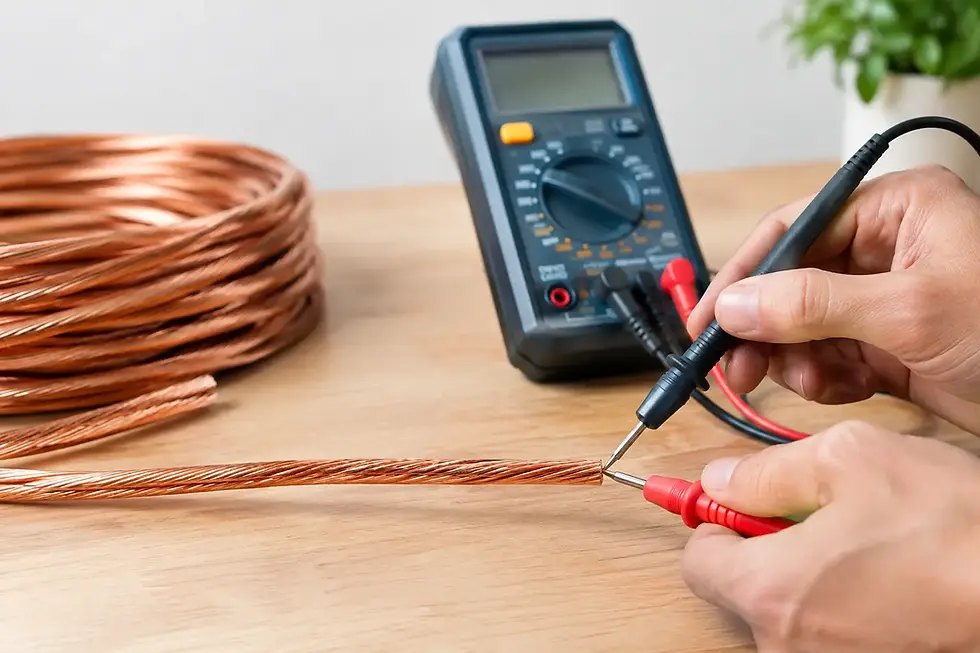
Common tests may include conductor resistance, high-voltage testing, insulation integrity checks, dimensional verification, and physical tests on insulation and sheath materials. Depending on the cable type, additional flame, aging, or mechanical tests may also apply.
For experienced buyers, test capability is one of the clearest signals of manufacturing seriousness. It shows whether the producer is simply running material through a line or actually controlling a technical product. ECI Wires serves international industrial demand with this kind of production focus, where manufacturing accuracy and export readiness need to work together.
What affects quality, lead time, and price
Buyers often ask which stage matters most. The honest answer is that weak control at any stage can affect the finished cable. Conductor quality influences electrical performance. Extrusion stability affects safety and durability. Poor assembly creates dimensional and installation issues. Weak testing allows defects to leave the factory.
Lead time depends on more than machine availability. Material availability, design complexity, test requirements, order volume, and packaging format all affect production planning. Standard products move faster. Custom constructions take more coordination, especially when technical approval is required before manufacturing starts.
Price follows the same logic. Metal content is a major cost driver, but not the only one. Compound selection, armor, screening, tolerances, testing scope, and reel length also matter. For industrial buyers, the lowest unit price is not always the lowest total cost once installation efficiency, service life, and claim risk are considered.
Why buyers should understand the process
A buyer does not need to operate an extrusion line, but understanding the industrial cable manufacturing process makes specification and supplier evaluation far easier. It helps identify where a cable is truly fit for purpose and where a quotation may be cutting corners.
This is especially relevant in international sourcing. When cables are being supplied across borders, clear technical alignment matters. Standards, conductor class, insulation type, marking, packaging, and test documentation should all match the project need before production begins.
The best cable supply relationships are built when both sides understand the product beyond the datasheet. A reliable manufacturer is not only producing cable. It is controlling variables that determine whether the cable performs as expected once it is installed in the field.
The practical value for buyers is simple: when you know how a cable is made, you ask better questions, compare offers more accurately, and choose supply that supports the job instead of creating risk after delivery.


Comments