


OEM Cable Manufacturing for Global Supply
- Eci Wires

- Apr 10
- 5 min read
When a cable is specified into a machine, panel, production line, or infrastructure package, failure is rarely caused by the drawing alone. It usually comes from the gap between specification and production. That is where OEM cable manufacturing matters. For buyers managing repeat builds, export shipments, or project-based supply, the right manufacturing partner is not just producing cable - it is controlling consistency, documentation, and delivery against a real operating requirement.
What OEM cable manufacturing means in practice
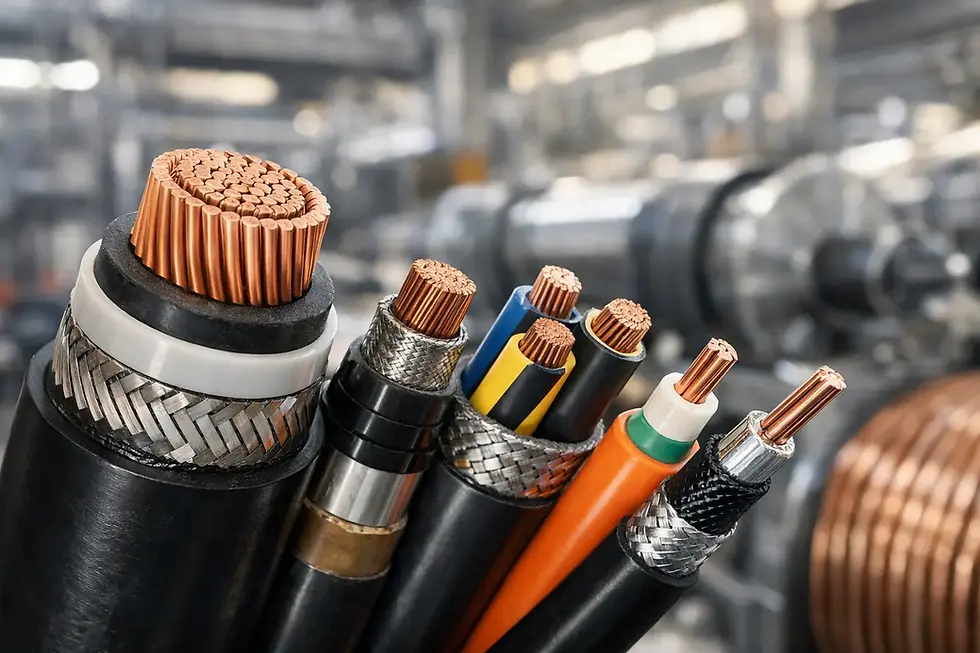
OEM cable manufacturing is the production of cables made to an original equipment manufacturer's design, performance target, or application requirement. In some cases, that means a fully custom cable with defined conductor class, insulation compound, shielding, sheath material, voltage rating, and marking. In others, it means adapting a standard construction to fit a machine builder's installation method, environment, or certification needs.
For industrial buyers, the value is straightforward. A standard catalog cable may be available faster, but it does not always fit the application. Bend radius, oil resistance, temperature range, conductor flexibility, flame behavior, or packing format can affect performance in the field. A supplier with OEM capability helps align production with actual use instead of forcing the application to fit a generic product.
This matters even more in export markets. Equipment manufacturers and distributors often need one supplier that can manage technical customization while also supporting international shipment, repeat ordering, and commercial consistency. If the production side is strong but export execution is weak, delays move from the factory floor to the port. If export capability exists without manufacturing control, quality variation becomes the bigger risk.
Where OEM cable manufacturing adds the most value
The strongest use case for OEM cable manufacturing is repeat industrial demand with technical specificity. Machine builders often need cables that fit fixed routing paths, moving components, compact terminals, or harsh environments. Panel builders may require consistent outer diameter, clear identification, and manageable stripping performance for assembly efficiency. Infrastructure and construction buyers may need low voltage cables aligned with project documents, packaging needs, and destination market expectations.
There is also a commercial reason to choose OEM production. When a buyer standardizes a cable for ongoing use, stable sourcing matters as much as the initial technical fit. A manufacturer that understands repeat production can help reduce variation between batches, maintain traceability, and support predictable lead times. That is especially useful for distributors and importers serving multiple downstream customers who expect continuity, not one-off substitutions.
The trade-off is that custom production requires more alignment at the start. Standard items can move quickly from stock. OEM supply usually needs specification review, confirmation of materials, sample approval in some cases, and planned production scheduling. Buyers that manage this process well usually gain better long-term control, but they should expect more technical discussion upfront.
Key factors buyers should evaluate
Not every cable supplier is set up for OEM work, even if custom supply appears in a catalog. The difference is operational. A capable OEM manufacturer should be able to translate technical requirements into a buildable product and then reproduce it consistently across future orders.
Engineering fit and material selection
The first question is whether the manufacturer understands the application, not only the requested part. Copper or aluminum conductor choice, insulation type, sheath compound, shielding design, and temperature performance all depend on the end use. A cable for fixed indoor installation has very different priorities than one used in machinery, industrial plants, or export equipment exposed to variable environments.
This is where experienced buyers look beyond price alone. Lower-cost material decisions can be valid in some installations, but not if they reduce service life, create installation issues, or affect compliance with project requirements. A useful manufacturer will explain where cost can be optimized and where it should not be reduced.
Production consistency
OEM programs succeed when repeat orders match approved construction. That means conductor dimensions, insulation thickness, outer sheath quality, marking clarity, and overall cable handling characteristics should remain stable. Small deviations can create real problems in assembly or site installation, especially when equipment is built around narrow tolerances.
Consistency depends on process control, not marketing claims. Buyers should expect disciplined manufacturing practice and clear technical confirmation before production starts. For larger or repeat-volume programs, this becomes more important than a one-time quoted price.
Compliance and documentation
Industrial and export buyers often need more than a cable reel and invoice. They may require technical data sheets, test information, packing details, country-of-origin paperwork, or product labeling adapted to market needs. In OEM cable manufacturing, documentation is part of the product. If the cable is right but the paperwork is incomplete, the shipment can still fail at the customer or customs level.
Requirements vary by destination and application. Some buyers need strict alignment with tender documents. Others need practical test reporting and shipment marking for warehouse control. A supplier that handles both manufacturing and export documentation reduces friction across the whole order cycle.
Standard products versus custom OEM production
Many industrial buyers do not need a fully custom cable on every order. In fact, a good supply partner should be honest about when a standard low voltage cable is the smarter choice. If the application is conventional and available constructions already match the need, standard production may offer faster lead times and lower cost.
Custom OEM manufacturing makes more sense when standard products create compromises. That may involve space limitations, installation conditions, identification requirements, special conductor stranding, or project-specific packing. It may also apply when a buyer wants to consolidate sourcing under one manufacturer that can supply both standard and made-to-order cable.
That hybrid capability is often the most practical model for international B2B buyers. It supports routine demand efficiently while still allowing custom production for higher-spec or application-specific orders. ECI Wires operates in this space by combining industrial cable manufacturing with export supply flexibility, which is often more useful to procurement teams than a purely stock-based offer.
Why export experience matters in OEM cable manufacturing
For international buyers, cable quality is only one part of supplier performance. OEM cable manufacturing for global markets requires a manufacturer that understands packing, labeling, shipment coordination, and order accuracy across borders. A technically correct cable delivered late, packed poorly, or documented incorrectly still creates project risk.
Export experience usually shows up in practical details. Reel size may need to match container planning or site handling. Marking may need to follow buyer language or project format. Partial shipments may or may not be acceptable depending on the installation schedule. These issues are not secondary. For importers, contractors, and OEMs serving multiple markets, they are part of the purchase decision.
There is also the matter of communication speed. Buyers sourcing internationally often work across time zones and fixed project timelines. A supplier should be able to confirm specifications, production status, and shipment readiness clearly. That reduces delays during technical approval and helps avoid costly revisions after production begins.
A practical way to qualify an OEM cable supplier
The most effective qualification process is not complicated, but it should be specific. Start by checking whether the supplier asks the right technical questions. A serious manufacturer will want to understand voltage rating, conductor material, insulation and sheath preference, installation environment, movement conditions if any, shielding requirements, and destination market expectations.
Then assess whether the commercial side matches the technical side. Can the supplier support repeat ordering? Are lead times realistic? Is export packing handled professionally? Can standard and custom products be sourced from the same manufacturing base when needed? A reliable partner should make these points clear without overpromising.
Finally, look at fit over time, not just for one purchase. OEM cable manufacturing works best when the supplier can support future revisions, stable quality, and volume growth. That matters for machine manufacturers scaling production, distributors managing recurring demand, and project suppliers handling phased delivery schedules.
A cable order may look simple on paper, but industrial supply rarely is. The right OEM manufacturing partner helps reduce variation, support compliance, and keep supply aligned with the application and the market. For experienced buyers, that is not a purchasing detail. It is part of keeping projects moving with fewer surprises.


Comments