


What Is Fiber Optic Cable Used For in Industry?
- Eci Wires

- 3 days ago
- 5 min read
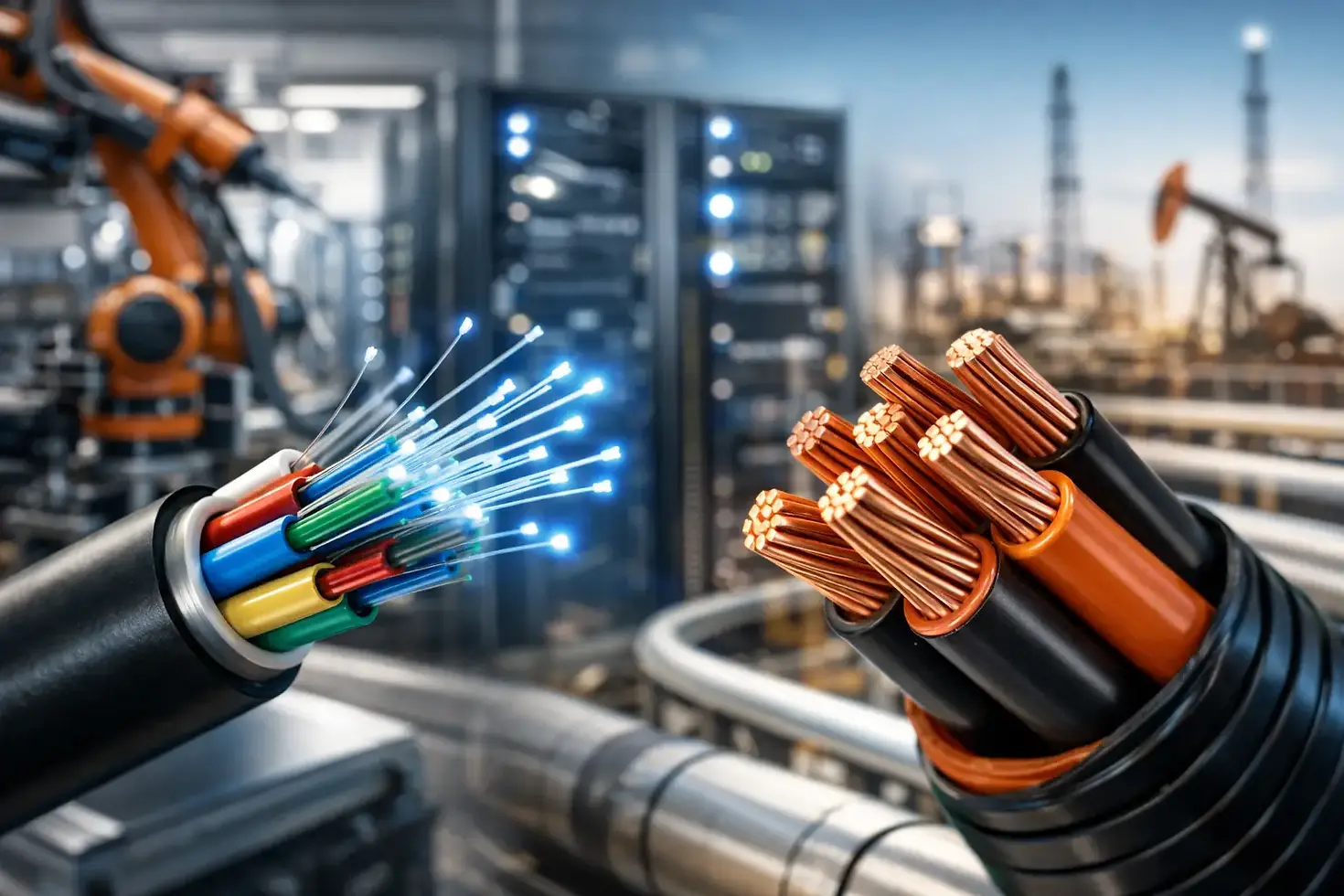
A production line stops when the control network drops, not when a cable looks damaged. That is why procurement teams, contractors, and OEMs ask, “what is fiber optic cable used for?” before selecting a communication cable. Fiber optic cable carries data as pulses of light, allowing high-capacity communication over long distances while avoiding the electrical interference that can affect copper data cabling.
For industrial and infrastructure buyers, the answer is broader than internet connectivity. Fiber supports automation, monitoring, security, telecommunications, and critical operational systems. The correct cable depends on distance, bandwidth, installation environment, termination method, and the level of mechanical protection required.
What Is Fiber Optic Cable Used For Across Industrial Projects?
Fiber optic cable is used to transmit voice, video, data, and control signals between equipment, buildings, sites, and network nodes. Its glass or plastic optical fibers transmit light rather than electrical current. This makes fiber especially useful where long cable routes, electromagnetic interference, high data volumes, or electrical isolation are factors.
In a factory, fiber can connect programmable logic controllers, machine networks, supervisory systems, and remote panels. In an industrial park or utility facility, it can connect substations, control rooms, cameras, and communications cabinets. In commercial and public infrastructure, it forms the backbone between buildings, telecommunications rooms, data centers, and access networks.
Unlike conventional power cable, standard fiber optic cable does not deliver electrical power to equipment. Its role is communications. Some projects use hybrid constructions that combine optical fibers with copper conductors in one cable, but the fiber element still carries data while the copper conductors carry power.
Telecommunications and broadband networks
Telecommunications networks are one of the largest uses of fiber optic cable. Network operators use it for backbone routes between cities, regional connections, fiber-to-the-building systems, and access networks serving businesses and homes. A single cable can contain multiple fibers, enabling network capacity to expand without installing a separate route for every service.
Single-mode fiber is generally selected for long-distance telecommunications because it supports transmission over much longer routes and at higher bandwidths. It is commonly used for metropolitan, intercity, and campus backbone connections. The active equipment and optical modules determine actual network speed, but the fiber provides a stable path for future capacity upgrades.
Industrial automation and control networks
Industrial sites can be electrically noisy environments. Motors, variable frequency drives, welding equipment, switching devices, and high-current power circuits may introduce electromagnetic interference. Fiber is immune to this interference because it carries light rather than electrical signals.
This advantage is valuable for communication links between production areas, remote I/O panels, control rooms, warehouses, and process equipment. Fiber also provides galvanic isolation between connected systems. Where facilities have different grounding conditions or exposure to electrical faults, optical links can help reduce the risk of unwanted electrical paths through communication cabling.
However, fiber is not automatically the best choice for every short machine connection. Copper Ethernet may be more economical for short, protected runs with moderate data requirements. Fiber becomes more compelling when distance, interference, lightning exposure, isolation, or network availability justifies the additional components and installation work.
Data centers, enterprise networks, and campuses
Data centers rely on fiber optic cable for high-speed connections between switches, servers, storage systems, and distribution frames. Large commercial buildings, airports, hospitals, universities, and business campuses also use fiber as a backbone between telecommunications rooms and separate buildings.
Multimode fiber is often used for shorter, high-speed links inside buildings and data centers. It can support cost-effective optical hardware over shorter distances. Single-mode fiber is often chosen where routes are longer, where a site expects future expansion, or where consistency with wider campus and carrier networks is preferred.
The design decision should not be based on fiber type alone. Buyers should review channel length, connector interfaces, transceiver compatibility, patching requirements, redundancy design, and the expected life of the installation. A low initial cable price has limited value if the selected construction restricts future network equipment choices.
Security, surveillance, and access control
Fiber is widely used in CCTV networks, perimeter protection, intelligent traffic systems, and access-control infrastructure. High-definition cameras generate substantial data, particularly when many cameras operate continuously or video is retained centrally. Fiber provides the capacity needed to move this traffic over long routes without the distance limitations of typical copper Ethernet runs.
For outdoor security systems, fiber also helps separate sensitive network equipment from lightning-prone field locations. Routes through industrial yards, ports, transportation facilities, and large construction sites may require armored, direct-burial, or duct-rated cable constructions. The cable must be specified for the physical installation, not only for its optical performance.
Utilities, transportation, and public infrastructure
Power utilities use fiber for substation communications, protection systems, remote monitoring, and operational networks. Transportation projects use it for traffic signals, toll systems, railway communications, station networks, passenger information systems, and surveillance. Municipal infrastructure may use fiber to connect control systems for water treatment, pumping stations, and public facilities.
These applications typically place greater emphasis on reliability, route protection, and environmental resistance. Outdoor cables may need protection against moisture, UV exposure, crushing loads, rodents, tensile stress, or underground installation conditions. A cable that performs well in an indoor riser route may not survive direct burial or aerial installation without the right jacket and strength members.
Selecting Fiber Optic Cable for the Installation
The first choice is usually between single-mode and multimode fiber. Single-mode is the standard choice for long-distance links and is common in telecom, utility, and large-site infrastructure. Multimode is generally suited to shorter-distance building and data-center links. Network designers should define the required transmission distance and active equipment before finalizing this selection.
Cable construction is equally important. Indoor cables may prioritize flexibility, flame performance, and easy termination. Outdoor cables often require water-blocking materials, UV-resistant jackets, and stronger protection. Armored designs can provide added defense against crush forces and rodent damage, while loose-tube designs are frequently selected for outdoor backbone routes. Tight-buffered designs are common where indoor handling and direct termination are priorities.
Fiber count should be planned beyond immediate demand. Installing additional fibers during civil works can be far more economical than reopening ducts, trenches, or cable trays later. Spare fibers support expansion, repairs, redundancy, and separate systems such as security or building management. Still, excessive capacity without a defined route plan can add unnecessary cost, so the right count depends on expected growth and project scale.
Buyers should also confirm jacket material, fire classification, operating temperature, pulling tension, minimum bend radius, cable diameter, and compatibility with ducts, trays, conduits, or aerial hardware. For projects with local code requirements, the cable construction and fire rating must match the installation area. Technical documentation should clearly state the applicable fiber standard, attenuation values, mechanical performance, and packaging lengths.
Installation Quality Matters as Much as Cable Quality
A fiber network can fail to meet its performance target even when the cable itself is correctly manufactured. Excessive pulling force, sharp bends, poor splicing, contaminated connectors, and incorrect routing can create signal loss. Installation teams should follow the manufacturer’s pulling limits and bend-radius requirements from delivery through final termination.
Testing is part of project acceptance, not an optional extra. Optical power loss testing verifies end-to-end link performance, while OTDR testing can help identify splice loss, connector issues, breaks, and the location of faults along a route. Clear test records make future maintenance faster and provide useful evidence during handover.
For international industrial supply, cable selection also benefits from early coordination between the project engineer, installer, and procurement team. ECI Wires supports standard and project-specific fiber cable requirements for export markets, where packaging, drum length, documentation, and delivery planning can be as important as the cable specification itself.
Fiber optic cable is most valuable when it is treated as part of a complete communications system rather than a standalone commodity. Define the route, environment, network equipment, protection needs, and future capacity before ordering. That approach helps ensure the installed cable remains useful long after the first devices are connected.

Comments